|
|
|
Data Recovery
24/7
To Locations Worldwide |
|
 |
|
|
|
|
HOW
DOES RAID 5 WORK? |
|
|
A RAID 5 array uses a
minimum of three disk drives and stripes data and
parity information
across all of the drives. A RAID 5 array has the ability
to withstand the loss of one drive
as the
parity information can help reconstruct the data from the failed
drive. The total size
of the array is calculated by
multiplying the capacity of the smallest drive times the number
of
drives, and then subtract the capacity of the smallest drive. A RAID 5
has a fast read
rate, but it tends to
write to
the
drives slowly
since it must write one stripe of both data and
parity to each
drive. A
RAID 5
can
be created
with hardware or software.
RAID 5 is frequently used in
many different types of
servers such as file
and application
servers,
intranet servers, email servers and for
database applications.
As it is
generally
fault tolerance
and cost efficient, companies are
using RAID 5
as their preferred choice.
For more
information
about the devices using RAID 5 technology,
click here.
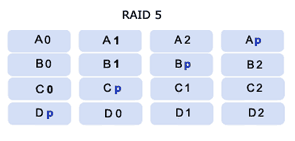
The following diagram
illustrates a RAID level 5 (striping with parity).
|
|
WHAT CAUSES RAID FAILURE? |
|
|
There can be many reasons for
a failed RAID 5.
Listed below are the most common:
|
|
|
|
|
|
|
|
 |
Bad Sectors in the Array |
|
Missing
Partitions |
|
|
|
Corrupt Data in the Array |
|
Overwritten
Files |
|
|
|
Corrupt Files in the RAID |
|
RAID Backup Failed |
|
|
|
RAID
Controller Failure |
|
Broken RAID 5 |
|
|
|
Damaged Files in the Array |
|
RAID 5 Offline |
|
|
|
Deleted Files in the Array |
|
RAID Crashed |
|
|
|
Failed RAID 5 |
|
RAID
Firmware Failure |
|
|
|
RAID 5 Drive
Failed |
|
Power Surge |
|
|
|
RAID
Power
Failure |
|
Array Will Not Boot |
|
|
|
RAID Rebuild
Failed |
|
MFT Corruption |
|
|
|
|
|
|
|
|
WHAT
TO DO IF YOU EXPERIENCE RAID 5 FAILURE |
|
|
If you experience
problems with your RAID 5 array, please do not attempt
to correct the
problem
yourself. By taking matters into your own hands, you
could overwrite parity data
making RAID
recovery more difficult. Please follow
the steps below and contact ReWave
for assistance at
866-739-2835.
|
Turn off your RAID 5 array immediately.
This ensures that no additional data
can be written to the array, which could overwrite the data
you are trying to recover.
|
|
|
|
Document the events that occurred causing RAID 5 failure. Try to
make
notes documenting any problems that occurred and efforts
that were made to fix the
problems. If you remove
the drives from the array, it is
important to label the drives
with the same order in which
they existed in the array. Although not required, this
step will save us time during the RAID recovery process. |
|
|
|
Contact ReWave immediately. Our data recovery
team is available 24/7 to assist
you with RAID recovery at 866-739-2835. |
|
|
|
Data
Recovery |
RAID Recovery |
Desktop Data Recovery |
Laptop Recovery
| Server Recovery |
Mac Recovery | Linux
Recovery |
Novell Recovery |
Windows Recovery |
Outlook PST Recovery |
Quickbooks Recovery |
RAID 0 Recovery |
RAID 1 Recovery |
RAID 5 Recovery |
RAID 10 Recovery |
Locations Served
|
|
|
|
|
|
|
|
|
|
|