We offer a free evaluation and
free price quote to determine recovery cost
Our 24/7 service
allows us to recover your lost RAID data quickly!
We have over 18
years of experience recovering failed RAID arrays
We have a 96% success
rate recovering failed RAID arrays
We provide RAID recovery
for any type of server or operating system
We recover data from all RAID levels (0, 1, 5, 6, 10, 50 & more)
THE
RAID RECOVERY PROCESS
Contact ReWave toll-free at 866-739-2835 or
click here to submit
a form for a free price quote. We are
available
24/7 for your RAID
recovery needs.
A
data recovery technician will assist you
with a free price quote and instructions to receive the free evaluation to
determine if your
data is recoverable.
You can bring your RAID
drives
to one of our
labs
or
ship the drives to
us using our
shipping instructions.
Upon receipt of your drives, a data recovery engineer
will perform
the free evaluation.
You
will be contacted
with the results and
given the option to proceed
with the
recovery of your data. The
actual recovery process will then
begin.
HOW
DOES RAID 10 WORK?
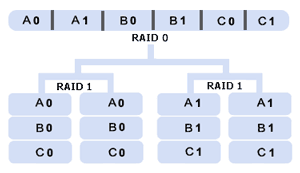
RAID 10 (also called RAID 1+0) uses a
minimum of four drives and additional drives must
be added in
even numbers.
If four drives are used, a pair is first mirrored as in a RAID 1
and then
striped as in RAID 0. The
total storage capacity is calculated by summing the
storage
capacity
of all the drives in the array
and dividing it in half. This makes RAID 10
very expensive since it
uses only half of the total capacity of all the drives. RAID
10 does
offer increased
performance
over some of the other RAID levels due to the striping that
takes
place. Since mirroring occurs
in RAID 10, the
failure of one or more drives is
tolerable as
long as there is only one failure per
each mirrored pair.
RAID 10 is frequently used in
different types of servers that demand high performance
and also in many network attached storage (NAS) devices. For more
information about
the
NAS devices with built-in RAID 10 technology, click here.
The following diagram
illustrates a RAID level 10 (a stripe of mirrors).
WHAT CAUSES RAID FAILURE?
There can be many reasons for
a failed RAID 10.
Listed below are the most common:
Bad Sectors in the Array
Missing
Partitions
Corrupt Data in the Array
Overwritten
Files
Corrupt Files in the RAID
RAID Backup Failed
RAID
Controller Failure
Broken RAID
Damaged Files in the Array
RAID Offline
Deleted Files in the Array
RAID Crashed
Failed RAID 10
RAID
Firmware Failure
RAID 10
Drive Failed
Power Surge
RAID
Power
Failure
Array Will Not Boot
RAID Rebuild
Failed
MFT Corruption
WHAT
TO DO IF YOU EXPERIENCE RAID FAILURE
If you experience
problems with your RAID 10 array, please do not attempt
to correct the
problem
yourself. By taking matters into your own hands, you
could overwrite parity data
making RAID
recovery more difficult. Please follow
the steps below and contact ReWave
for assistance at
866-739-2835.
Turn off your RAID 10 array immediately.
This ensures that no additional data
can be written to the array, which could overwrite the data
you are trying to recover.
Document the events that occurred causing RAID 10 failure. Try to
make
notes documenting any problems that occurred and efforts
that were made to fix the
problems. If you remove
the drives from the array, it is
important to label the drives with the same order in which
they existed in the array. Although not required, this
step will save us time during the RAID recovery process.
Contact ReWave immediately. Our data recovery
team is available 24/7 to assist
you with RAID recovery at 866-739-2835.